Lime or cement render: why the choice decides the fate of the wall
The most expensive mistake in renovating an old house costs under €1 per m² at the moment it is made. It gets paid for five years later.
Every second old house we survey has the same problem: somebody has rendered a stone or brick wall in cement. It looks fine for three years. In the fifth, patches appear. By the seventh the render is coming away in sheets and the stone underneath is crumbling.
The cause is not poor workmanship. The cause is the choice of material.
How an old wall works
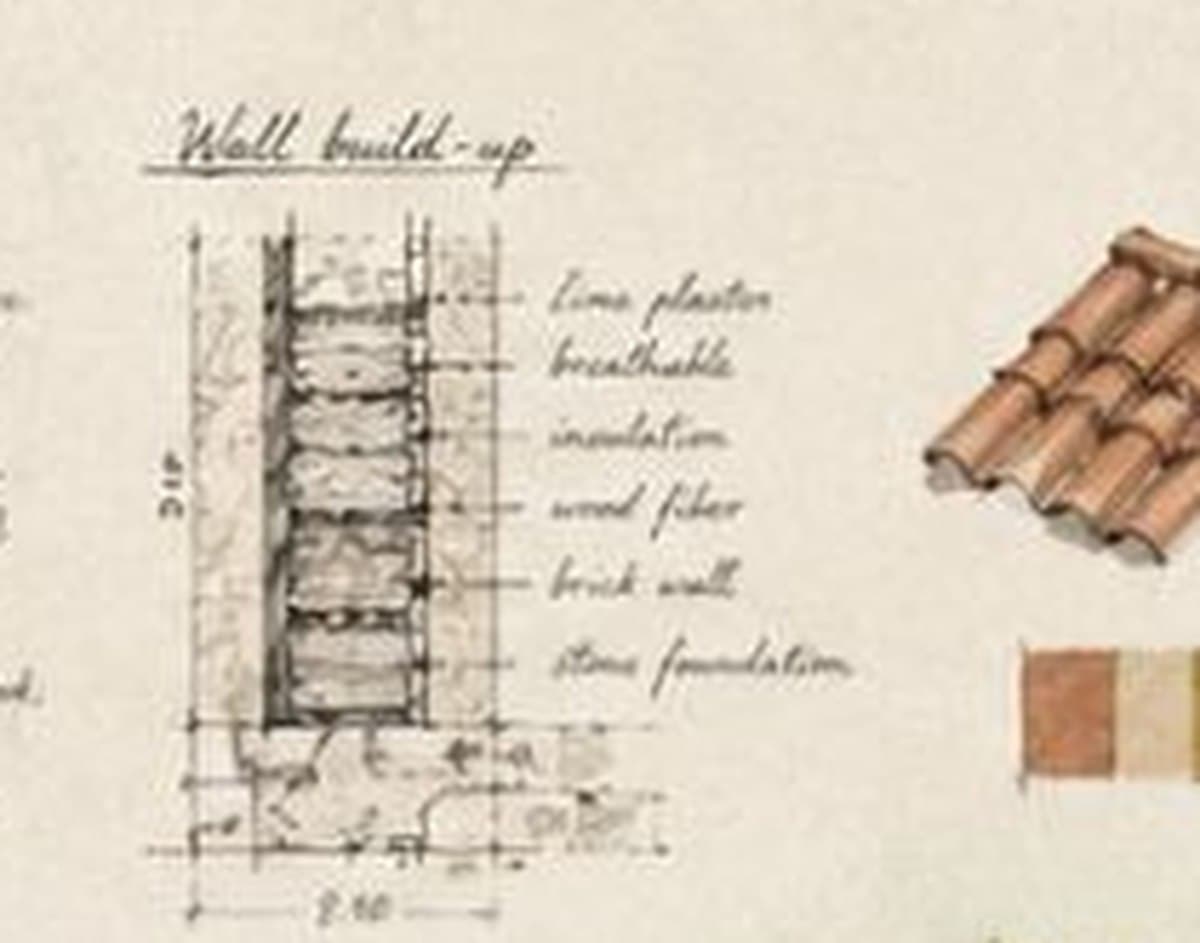
An old building without a damp-proof course draws moisture up from the ground. That is not a defect — it is its normal condition. The moisture rises by capillary action through the wall and has to leave somewhere.
Lime render allows exactly that. It is vapour-open: moisture passes through it and evaporates from the face of the wall. The wall takes in and gives back — in equilibrium.
Cement render is effectively impermeable. Moisture reaches it, cannot get out, and travels back into the masonry. There it freezes in winter, expands, and destroys the mortar and the stone from the inside.
An old house wrapped in impermeable materials does not stop absorbing moisture. It just loses the way to release it.
What we find on site
On a project in Balchik we found stone masonry repointed with cement mortar in the 1980s. The result after forty years:
- salt efflorescence on the internal ground-floor walls
- three loose stones on the south façade
- 78% moisture at 1.2 m above floor level
- flaking internal plaster along the entire north wall
We are raking the joints out by hand and replacing them with NHL 3.5 lime mortar. The pace is around 12 m² a week. Four months in, ground-floor moisture has fallen below 30%.
When cement is the right choice
We are not saying cement is a bad material. It is indispensable for:
- foundations and reinforced concrete elements
- plinths below ground level where there is a damp-proof membrane
- new build with an interrupted capillary path
- floor screeds
The problem is applying it to old masonry that relies on breathing to stay dry.
A practical guide
| Situation | Render |
|---|---|
| Stone masonry with no DPC | Lime |
| Brick house built before 1970 | Lime |
| New build with a damp-proof course | Cement or mineral |
| Wet rooms in an old house | Lime-cement, thin coat |
| Plinth below ground level | Cement with waterproofing |
The cost
Lime render costs roughly 30–40% more per square metre at the point of application and cures more slowly — that is its real price. Cement is cheaper, faster and easier to work with.
The difference gets paid when you have to strip 200 m² of render, wait a year for the wall to dry and re-render it. At that point the €900 you saved becomes €7,000.
If you are unsure what render is on your house, send us a close-up photo of a spot where it is flaking. It is usually recognisable from the colour and the way it fails.