Five signs a roof needs replacing rather than patching
The difference between a €2,000 repair and a €14,000 replacement is decided in the loft, not on the roof.
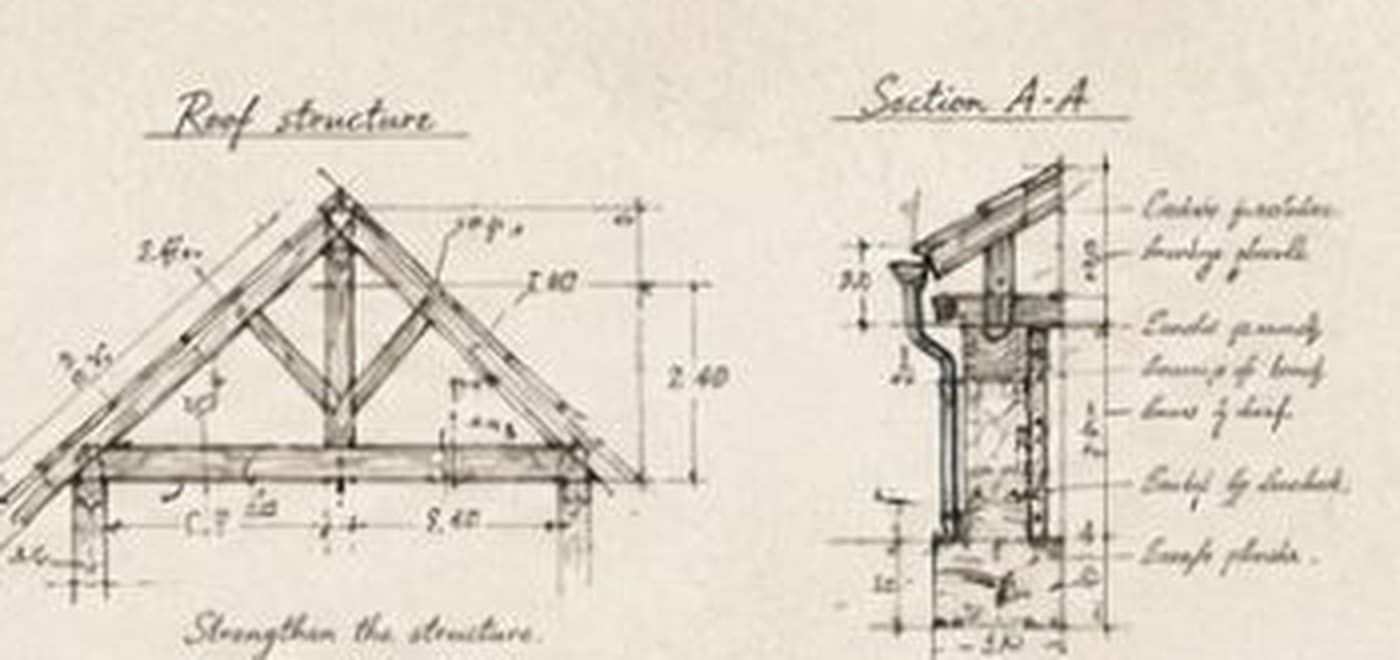
The roof is the only element of a house whose failure destroys everything else. A cracked wall stands for decades. A leaking roof ruins the joists, the plaster and the floors in three winters.
Here is what we check before recommending replacement.
1. A sagging ridge
Stand 20 metres from the house and look along the ridge line. If it is not straight but dips in the middle, the structure is overloaded or the bearing joints have failed.
A dip of up to 2 cm over 6 metres is acceptable on an old house. More than 5 cm means a structural problem that new tiles will not solve.
2. Dark staining on the joists, seen from the loft
Go into the loft with a torch on a sunny day. You are looking for:
- dark haloes where the joists bear onto the masonry
- white or grey bloom on the timber (mould)
- soft wood that gives when pressed with a screwdriver
- visible daylight between the tiles
Bearing joints rot first, because that is where timber sits against masonry and gets no ventilation.
3. Tiles that break when stepped on
Clay tiles last 80–120 years. Concrete tiles, 30–50. If tiles crack under a roofer's weight during the survey, the material has reached the end of its life and spot replacement is money thrown away.
4. No breather membrane
Houses built before 1990 rarely have a membrane under the tiles. That is not an emergency in itself, but it does mean every broken tile leads straight to a flooded loft.
If you lift the tiles and see only battens and sky underneath, a membrane must be part of any replacement.
5. Three or more repairs in the last five years
This is the most reliable indicator of all. If you have patched the roof three times and leaks keep appearing in new places, the roof does not have a local defect — it is at the end of its life.
The rule we use: if the estimated repair cost exceeds 40% of the replacement cost, replace it.
What a full replacement covers
| Item | Share of cost |
|---|---|
| Strip-out and disposal | 8% |
| Timber structure | 34% |
| Membrane and battens | 9% |
| Tiles and ridge pieces | 26% |
| Gutters and flashings | 11% |
| Scaffolding | 12% |
A medium roof of 120 m² takes 5–7 weeks including the scaffolding.
Can you live in the house during the work
Yes. On a project in Devnya we split the roof into four sections. Each section was taken down in the morning and closed with membrane by the evening. The family never moved out.
This approach adds around 15% to the programme and around 8% to the cost. On an occupied house it is almost always worth it.